
By Jessy Plante
Do you like building things?
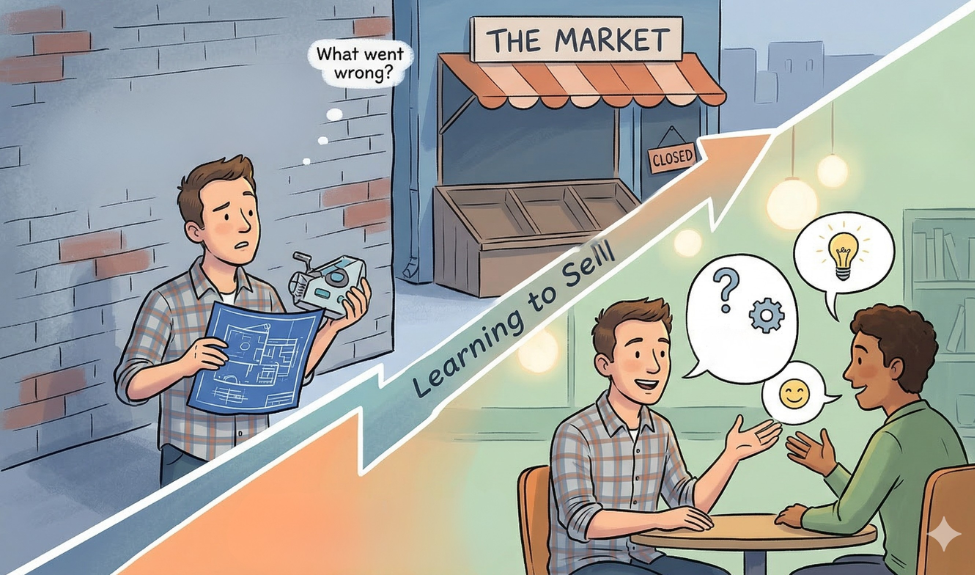
Many founders do. You build a product you believe will revolutionize the way people work. You refine it until it feels perfect. Then you bring it to market… and nothing happens.
No mass adoption.
No flood of new customers.
Just one frustrating question:
What went wrong?
When you’re happily employed by someone else, it’s easy to imagine that you could do everything better on your own. But when you leave the comfort of a stable job to pursue your dream, reality hits like a brick wall.
Many entrepreneurs quickly learn why so many ventures fail:
they have a good product but don’t know how to, or want to, sell.
Learning to Sell
When I started my first sales role selling winery equipment, I had to figure everything out on my own. I had spent years making wine around the world and understood the equipment inside out. I had also practiced my communication skills through a public speaking club. I knew the product and how to speak, but I didn’t know how to combine the two to sell.
So I started learning the only way I could: book after book about sales. Turning theory into practice was difficult on my own, but eventually I developed a cold-calling script that set appointments about 25% of the time. One afternoon, I made five calls and booked four meetings.
Be Interesting
In today’s world of automation and A.I., much of the outreach people receive has become generic and recycled. The same messages are pushed onto thousands of people in the hope that it’ll stick somewhere. I prefer a different approach: getting better results with human-centric conversations.
That philosophy eventually became the foundation of my company, Life Jugglers. We focus on products that help people save time and energy, tools that improve communication for both sellers and buyers. So you can spend less time between sales calls and more time in them.
Earn their Attention
First, you need to earn their attention. To do that, you have to stop focusing on your desire to sell them something and start focusing on their desire to solve a problem they are having.
How would what you are selling make their life easier?
Your job is to figure out the answer to that question. The sooner you can show that your product can resolve their problem, the sooner the conversation will shift to the specifics of how it will do so.
To understand their problem, you need to ask questions and listen to the answers.
The first question you ask is the most important. It determines whether the person you’re speaking with will want to continue the conversation or not.
The courses I offer focus on improving collaborative communication in sales. If the person I’m speaking with works in sales or manages people who do, then there is a good chance they want their company’s sales conversations to be more effective. If they don’t, then the conversation naturally ends, and that’s okay.
The Principle of the Easy “No”
Collaborative communication focuses on listening for that easy “no.” Instead of pushing a conversation forward, you pay attention to the other person to gauge their interest. Any clear indication that they want the conversation to end is enough for you to end it.
Either it’s an obvious yes, or it’s an easy no.
When people know they can say no without pushback, conversations flow more smoothly. When someone continues to talk with you because they actually want to, the discussion becomes mutually beneficial.
So the real skill in starting a sales conversation is curating smooth conversations that gently nudge someone toward an obvious “yes” or stop at an easy “no.”
How well can you recognize when someone is giving you that easy “no”?
